

Most owners can tell you how good their work is. Fewer can tell you what happened to last Tuesday's text message, or whether the person holding Saturday at 10 ever paid.
That isn't carelessness. An owner who is on the job all day can't also answer every message the moment it lands, chase every unpaid hold and send every review request. So those jobs get done late, or not at all. That gap is the leak.
We look for three gaps before we propose any system. We found all three in our own training business, Tactical U Firearms Training in Fort Lauderdale, before we offered to fix them for anyone else.
1. Why does a new inquiry go unanswered?
Usually because nobody owns the reply at the moment it arrives. A text at night, a form at lunch, a voicemail during class: each one sits until you have a free hand, and the prospect can move on before you get back to them.
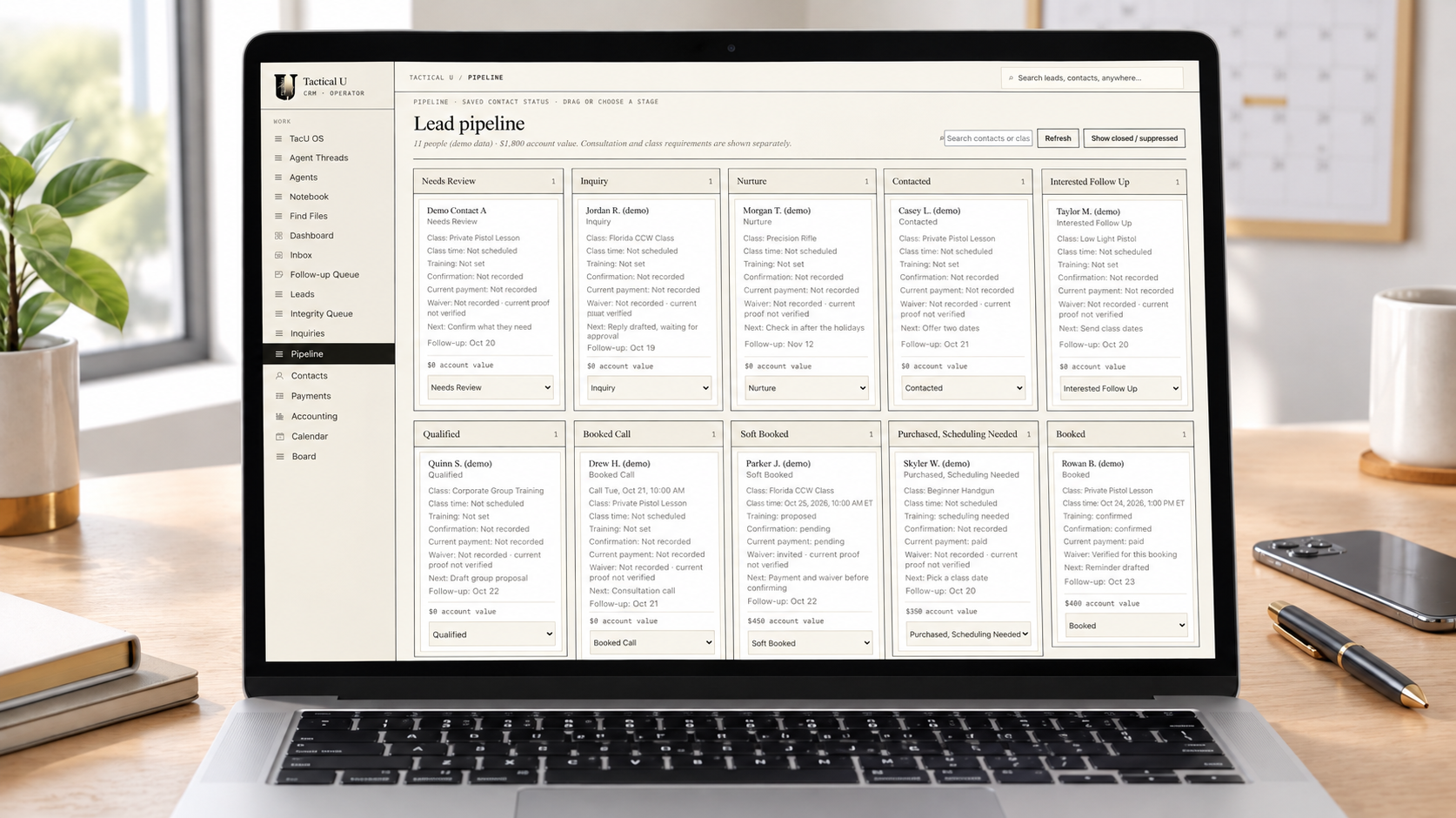
Part of the problem is volume, and part of it is scatter. At Tactical U, inquiries arrived by email, text, Google Voice, web forms and voicemail. The same customer could show up under three spellings of their name. When messages live in five places, nobody can see what is still waiting.
The fix has two parts. First, put every channel into one inbox with one record per customer, so tonight's text is attached to the email the same person sent in March. Second, have the reply drafted the minute the message arrives, so the owner only has to read it and approve it.
Our proof page walks through an example built from how real bookings move, with names and times changed. A text comes in at 9:12 on a Tuesday night asking about a private lesson. By 9:13 a reply is drafted and waiting. At 6:40 the next morning the owner reads it, changes one word and taps approve.
2. What goes wrong when a date is held but never paid?
It can block another customer who was ready to pay. The slot looks like a booking on the calendar, but there is no payment and no paperwork behind it.
At Tactical U, dates used to be held on the calendar before any payment was in. Businesses that take orders have the same leak in a different form: a custom order or a quote committed before the deposit or the agreed terms are in place.
It also makes a no-show cost more. Someone who has not paid and has not signed anything has nothing at stake. If they don't show, the slot is lost, and so is the customer you turned away for it.
The fix is a rule, followed every time. A hold starts as tentative. It becomes firm only when the payment is matched to the invoice and the paperwork, such as a waiver or a signed agreement, is in. And every hold gets a deadline. If the money isn't in by then, someone follows up or lets the slot go, so it never just sits there blocking a paying customer.
Our own progress, as of October 16, 2026: at Tactical U we check payments against QuickBooks invoices every day. Letting unpaid calendar holds go on their own is the part we haven't finished.
3. Why does the follow-up never go out?
Usually because it lives in the owner's memory, and the owner is already on the next job. The work went well and the customer was happy. Then nothing happened: no reminder before the next visit, no thank-you, no review request, no offer for the next class or order. The customer liked you and still forgot you.
At Tactical U, follow-ups and review requests used to go out when there was time.
The fix is to put the follow-up on the customer's record. Each finished job gets its reminder, thank-you and review request drafted in fresh wording, not pasted from a template, and the owner approves them. Then someone checks that they actually went out, and a note goes on the customer's record.
Can you set up automatic follow-up emails?
Yes, for the routine ones. A booking confirmation or a reminder of when to arrive says the same thing every time, so it can go out on its own once you have approved the wording. Thank-yous, review requests and next offers are different: they are about one customer, so we draft them fresh and you approve each one. Either way, the follow-up is due on the record, not in your memory, so you can see whether it happened.
How can you check your own front office for leaks?
You don't need new software to check. Pick five recent inquiries or orders and trace each one from the first message to paid. For each one, ask:
- Who replied, and how long did it take?
- Was the date or order held before the payment or agreed terms were in place, and was it released on time if they never came?
- Did the reminder, the thank-you and the review request go out, and can you show where?
If any of the five stalled, you have found a leak. If you can't tell whether they stalled, that counts as a leak too, because nobody can fix what nobody can see.
Our free Front Office Score asks six questions along these lines and takes about two minutes. It works out your score out of 100 in your browser; nothing is sent unless you choose to send it, and it lists the fixes that would move your score most. If you want the deeper version, the paid Front Office Audit traces 90 days of your inquiries, bookings or orders, and payments with you, then hands you a written fix list ranked by money.
Straight answers
What are the three leaks Lights On AI looks for first?
The inquiry nobody answered, the date held but never paid, and the follow-up that never went out.
How can I tell if my business has these leaks?
Pick five recent inquiries or orders and trace each one from the first message to paid. If any of them stalled, or you cannot tell whether they stalled, you have found a leak.
What does the free Front Office Score cover?
Six questions on how your business handles inquiries, orders, payments, paperwork and follow-ups. It takes about two minutes, works out a score out of 100 in your browser, and nothing is sent unless you choose to send it.
How do you reduce no-shows?
Keep each date tentative until the payment and paperwork are in, and send a reminder before the appointment. Someone who has paid and signed has a reason to show up, and an unpaid hold is released before it blocks another customer.
What does the paid Front Office Audit add?
The audit costs $950 and takes ten business days. We trace 90 days of your inquiries, bookings or orders, and payments with you, then hand you a written fix list ranked by money. The fee is credited in full to any build, and if we cannot find more than the fee in leaks, we say so and refund it.